 English
 Español
 عربى
عربىContent
- 1 Corded Vacuum Cleaners Deliver Consistent, Powerful Suction for Everyday and Heavy-Duty Cleaning
- 2 Common Types and Characteristics of Corded Vacuum Cleaners
- 3 How Corded Vacuum Cleaners Work: Motor, Airflow, and Structural Principles
- 4 Corded and Cordless Vacuum Cleaners: Current Market Segment Share
- 5 Motor Power Trends and Energy Efficiency Standards for Corded Vacuum Cleaners
- 6 Application Scenarios and Selection Tips for a Powerful Corded Household Vacuum Cleaner
- 7 Corded vs Cordless Vacuum Cleaners: A Detailed Comparison
- 8 Typical Rated Input Power Ranges Across Corded Vacuum Cleaner Categories
- 9 Key Specifications to Evaluate When Choosing a Powerful Corded Vacuum Cleaner
- 10 Maintenance Guidance for Corded Vacuum Cleaners
- 11 Manufacturing Capability and OEM/ODM Support for Corded Household Vacuum Cleaners
- 12 Industry Trends Shaping Corded Vacuum Cleaner Design
- 13 Frequently Asked Questions About Corded Vacuum Cleaners
- 13.1 What is a corded vacuum cleaner and how does it differ from a cordless model?
- 13.2 Are corded vacuum cleaners more powerful than cordless vacuum cleaners?
- 13.3 What type of corded household vacuum cleaner is best for a large home?
- 13.4 How can I maintain consistent suction power in a corded vacuum cleaner?
- 13.5 Can a corded vacuum cleaner manufacturer support custom OEM or ODM orders?
- 13.6 Why do some corded vacuum cleaners have lower wattage than others in the same category?
Corded Vacuum Cleaners Deliver Consistent, Powerful Suction for Everyday and Heavy-Duty Cleaning
A corded vacuum remains one of the most dependable ways to achieve strong, uninterrupted suction across an entire home or facility, because it draws power directly from a wall outlet instead of a battery. For households, offices, and commercial spaces that need consistent performance from the first minute of cleaning to the last, a powerful corded vacuum avoids the gradual runtime limits and suction drop-off that are common with rechargeable models. This is why a corded household vacuum cleaner continues to be a practical choice for large living spaces, thick carpets, multi-room cleaning routines, and settings where cleaning sessions run longer than a typical battery charge allows.
This guide explains how corded vacuum cleaners are built, how their motor and airflow systems generate suction, which type of corded vacuum cleaner suits which environment, how corded models compare with cordless alternatives, and what specifications matter most when selecting or sourcing units for household or business use. Readers who manage facilities, run cleaning services, or evaluate household appliance product lines will also find practical selection criteria and maintenance guidance that apply across corded upright, canister, stick, and wet-and-dry vacuum formats.
A corded vacuum cleaner draws power directly from mains electricity, which gives it stable, continuous suction that does not decline as a cleaning session goes on.
Common Types and Characteristics of Corded Vacuum Cleaners
Corded vacuum cleaners are generally grouped into four main formats, each built around the same principle of constant mains power but shaped for a different cleaning task. Understanding these categories makes it easier to match a corded household vacuum cleaner to the size of a space, the flooring type, and how often the unit will be used.
-
Corded Upright Vacuum
A single-body design with the motor mounted directly above the brush head, favored for wall-to-wall carpet and large open rooms where a wide cleaning path saves time.
-
Corded Canister Vacuum
A separate body unit connected to the cleaning head by a flexible hose, offering better maneuverability around furniture, stairs, and upholstery than an upright format.
-
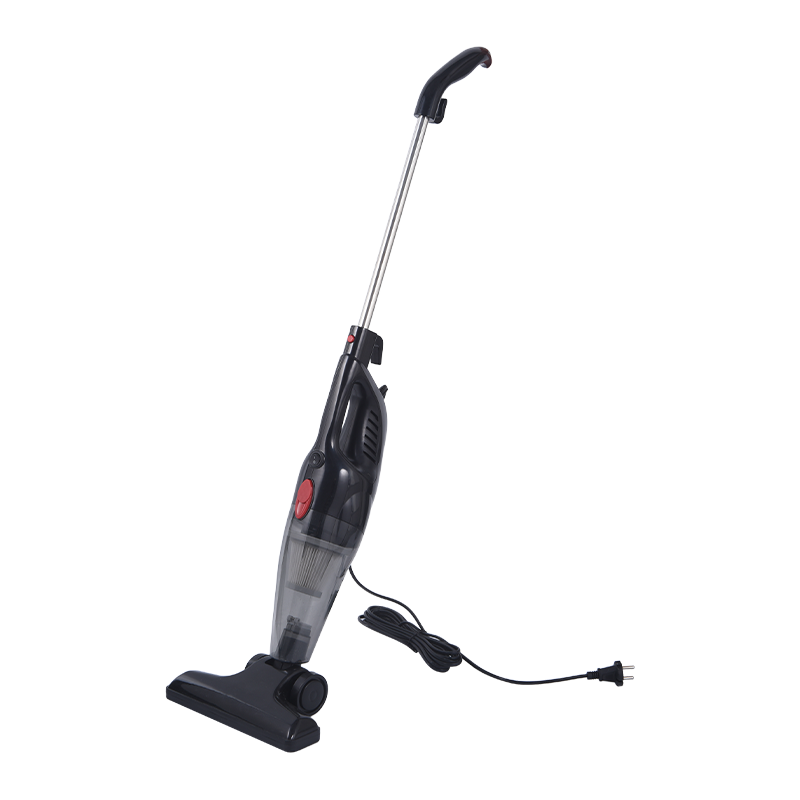
Corded Stick / Handheld Vacuum
A lightweight, slim-profile unit intended for quick cleanups, small apartments, cars, and hard-to-reach spots, trading dust capacity for portability.
-
Corded Wet and Dry Vacuum
A heavier-duty format built to pick up both liquid spills and solid debris, common in garages, workshops, and light commercial cleaning.
| Type | Typical Strength | Dust Capacity | Best Suited For |
|---|---|---|---|
| Corded Upright | Deep carpet agitation | Large | Large carpeted homes |
| Corded Canister | Versatile suction with hose | Medium to large | Mixed flooring, stairs, upholstery |
| Corded Stick / Handheld | Light, targeted pickup | Small | Apartments, cars, quick cleanups |
| Corded Wet and Dry | High-capacity, mixed debris | Large | Garages, workshops, light commercial |
Manufacturers that supply a full corded vacuum cleaner range typically design the upright and canister formats around similar motor and filtration platforms while adjusting the hose length, brush roll width, and dust chamber size for the intended room type. A corded vacuum cleaner manufacturer serving both household and light commercial buyers usually keeps this shared platform approach so that OEM and ODM partners can request configuration changes without redesigning the core motor system.
Choosing the right corded vacuum cleaner format starts with matching the flooring, room size, and cleaning frequency to the strengths of each type rather than assuming one format fits every space.
How Corded Vacuum Cleaners Work: Motor, Airflow, and Structural Principles
A corded vacuum cleaner works by using an electric motor to spin an internal fan at high speed, which creates a pressure difference that pulls air, along with dust and debris, in through the brush head. That airflow travels through a hose or duct into a dust chamber or bag, where larger particles settle out, before passing through one or more filters that capture finer dust and allergens. The cleaned air is then expelled through vents, usually near the rear or top of the unit, completing the airflow loop. Because the motor is powered continuously through the cord rather than by a battery, the fan speed and resulting suction stay steady rather than tapering off as a session progresses.
The diagram below shows a simplified isometric layout of a corded upright-style vacuum cleaner, with the main functional zones numbered for reference.
- Power Cord and Plug — supplies continuous mains power, removing runtime limits tied to battery charge.
- Handle and Power Switch — the main grip point, housing the on-off control within easy reach.
- Motor Housing — contains the electric motor and fan assembly that generates airflow and suction.
- Dust Collection Chamber — a bag or cyclonic bin that separates larger debris from the airstream.
- Filtration Vents — exhaust points where filtered air is released after passing through the filter stage.
- Flexible Hose — carries airflow from the floor unit up to the main body on canister-style designs.
- Extension Wand — connects the hose to the floor brush and adjusts reach and working angle.
- Rotating Brush Head with Wheels — agitates carpet fibers and rolls smoothly across the floor.
Because every one of these stages sits along the same continuous circuit, the overall performance of a corded vacuum cleaner depends less on any single part and more on how well the motor, hose diameter, and filter stage work together. A tight seal at each joint, a properly seated filter, and an unobstructed brush roll all matter as much as the motor's rated power when it comes to real-world suction at the floor.
Suction performance in a corded vacuum cleaner comes from the combined efficiency of the motor, airflow path, and filtration system, not from motor power alone.
Buyers comparing a corded household vacuum cleaner against a cordless model often assume that battery-powered units have already taken over the market. Industry data tells a more balanced story. Household vacuum cleaner demand is currently split across both power formats, with each format serving different buyer priorities. The chart below shows the household vacuum cleaner segment split reported for 2023. Looking at this distribution helps explain why corded models are still widely manufactured and sold rather than being phased out in favor of cordless designs.
According to a Grand View Research industry report on the household vacuum cleaner market, corded vacuum cleaners held a 59.7% share of the household vacuum cleaner market in 2023, ahead of cordless models. The report attributes this lead mainly to the more consistent, higher suction output that corded designs can sustain throughout a cleaning session, since they are not limited by battery capacity. Corded models were also noted as being generally more accessible for budget-conscious buyers, which supports steady replacement demand in addition to first-time purchases. A longer typical lifespan was cited as well, since corded units avoid the battery degradation that eventually affects cordless performance. At the same time, the same report projects that the cordless segment will grow at a faster rate going forward, driven by demand for portability and lighter body weight. Even with that faster projected growth rate for cordless models, the current market composition shows that corded vacuum cleaners remain the larger category by unit share rather than a shrinking legacy format. This matters for manufacturers and retailers deciding how to balance a household appliance product line, since it indicates continued, broad-based demand for corded models rather than a niche or declining one. For buyers, it also means that a powerful corded vacuum is not a compromise choice but one of the two mainstream options that most households are actively choosing between. Regional demand patterns add further context, since markets with larger living spaces and a preference for deep-clean carpet care tend to favor corded upright and canister formats specifically. Commercial and light-industrial cleaning also leans toward corded designs for tasks that require long, uninterrupted run times, which reinforces the household-level pattern shown in the chart. Taken together, the data suggests that a corded vacuum cleaner is best understood as a stable, high-suction option that continues to hold its own position in the market rather than a format on its way out.
Corded vacuum cleaners still account for the majority of household vacuum cleaner sales, reflecting steady consumer demand for consistent, uninterrupted suction power.
Motor Power Trends and Energy Efficiency Standards for Corded Vacuum Cleaners
A common assumption among shoppers is that a higher wattage rating automatically means a more powerful corded vacuum. Actual industry and regulatory data show a more nuanced picture. Over recent decades, average motor input power in domestic vacuum cleaners rose substantially before efficiency-focused standards began to limit that trend in some regions. The chart below plots this historical rise alongside two regulatory efficiency thresholds that apply in certain export markets. Reading these two data sets together helps explain why rated wattage alone is an incomplete way to judge suction performance.
According to the European Commission's overview of vacuum cleaner ecodesign policy, average domestic vacuum cleaner input power rose from around 1,200W in 1990 to roughly 2,300W by 2020 in markets without a wattage restriction, as manufacturers competed partly on power ratings that consumers associated with stronger cleaning. To address this, an ecodesign regulation introduced a maximum rated input power of 1,600W for vacuum cleaners sold in the European Union starting in 2014, which was then tightened to a 900W maximum from September 2017 onward, as confirmed by multiple regulatory and industry sources. Regulators noted at the time that a lower-wattage unit could match or exceed the cleaning performance of an older higher-wattage model when the motor, fan, and airflow path were engineered efficiently, since input power is only one factor behind actual suction and dust pickup. This means a corded vacuum cleaner built for an unregulated export market may carry a higher headline wattage figure than an equivalent unit built for the EU market, without that difference necessarily reflecting a proportional gap in real cleaning performance. For manufacturers supplying multiple regions, this creates a practical requirement to tune motor and airflow design separately for markets with different maximum input power rules rather than using a single specification worldwide. For buyers and B2B purchasers alike, the main takeaway is that wattage should be read alongside airflow, dust pickup performance, and filtration quality rather than treated as a standalone indicator of strength. A powerful corded vacuum in a regulated market is therefore typically the result of efficient motor and duct design rather than simply a high wattage rating on the label. This trend also explains why marketing language has gradually shifted in many markets from headline wattage figures toward measures such as airflow and dust pickup rate, which more directly reflect how a unit performs on carpet and hard floors.
Rated motor wattage is only one input into overall suction performance, and efficient motor and airflow design can deliver strong results even under lower power ratings.
Application Scenarios and Selection Tips for a Powerful Corded Household Vacuum Cleaner
Selecting the right corded household vacuum cleaner starts with matching the unit to where and how it will actually be used. The table below places common usage scenarios next to a practical selection checklist so the two can be compared side by side.
Typical Usage Scenarios
|
Selection Checklist
|
Cord length is another practical factor that is easy to overlook. A longer cord reduces the need to switch outlets mid-room, which matters more in larger homes and open-plan layouts than in compact apartments. Cable management features, such as a wrap hook or automatic rewind, also affect how convenient day-to-day use feels, even though they do not change suction performance directly. For buyers comparing a household vacuum cleaner wholesale order across several models, aligning brush width, hose flexibility, and cord length with the intended end-user environment tends to matter more than comparing wattage figures alone.
Matching brush width, hose flexibility, filtration level, and cord length to the specific cleaning environment leads to better real-world results than focusing on a single spec in isolation.
Corded vs Cordless Vacuum Cleaners: A Detailed Comparison
Choosing between a corded and a cordless vacuum cleaner usually comes down to a small set of trade-offs rather than one format being universally better. The radar chart below places five common decision factors side by side on a simple relative scale, illustrating typical operating characteristics generally associated with each format rather than results from a single test report. Reviewing these factors together, instead of one at a time, gives a clearer picture of which format fits a given household or facility.
The chart highlights that a corded vacuum cleaner generally scores higher on suction consistency and continuous runtime, since it is not limited by how much charge remains in a battery pack. This makes corded models a practical choice for longer cleaning sessions, larger floor areas, or professional cleaning routines where stopping to recharge would slow the work down. Cordless models, by contrast, score higher on portability, since there is no cord to manage and the unit can move freely between rooms and floors without searching for an outlet. Maintenance simplicity tends to favor corded designs slightly as well, since there is no battery to monitor, condition, or eventually replace as it ages. Upfront cost efficiency also tends to lean toward corded models, since the manufacturing cost of a mains-powered motor system is generally lower than that of a battery pack and its associated charging electronics. None of these factors make one format universally superior, since the right choice depends on how and where the vacuum will actually be used day to day. A large single-level home with open rooms may benefit more from a cordless unit's freedom of movement, while a multi-room home with heavy carpet may benefit more from a corded unit's sustained suction. Facilities that run long cleaning shifts, such as offices cleaned after hours, tend to favor corded or wet-and-dry corded units specifically because they avoid downtime for recharging mid-shift. Households prioritizing convenience for quick, frequent touch-ups may lean toward a cordless stick vacuum despite its shorter runtime. The comparison also underscores why many household appliance manufacturers maintain both corded and cordless lines rather than committing to a single format, since buyer priorities are genuinely split across these use cases. Looking at the radar shape as a whole, rather than any single axis, is the most useful way to decide which format better matches a specific cleaning routine.
| Factor | Corded Vacuum Cleaner | Cordless Vacuum Cleaner |
|---|---|---|
| Suction over time | Stays steady while plugged in | Can taper as battery depletes |
| Cleaning session length | Unlimited while corded | Limited by battery capacity |
| Mobility around rooms | Limited by cord length | Unrestricted movement |
| Long-term upkeep | No battery to replace | Battery eventually needs replacement |
A corded vacuum cleaner generally offers steadier, longer-duration suction, while a cordless model offers greater freedom of movement, making the choice a matter of matching format to routine.
Typical Rated Input Power Ranges Across Corded Vacuum Cleaner Categories
Rated input power varies noticeably across corded vacuum cleaner formats, largely because each format is engineered for a different cleaning job rather than a single universal task. The chart below sets out typical maximum input power figures seen across four common corded categories in markets without a wattage cap, alongside a reference line marking the 900W maximum that applies in EU-regulated markets from 2017 onward. Comparing these figures side by side shows how format, rather than brand positioning alone, tends to drive the power range a buyer should expect. This is particularly useful context for B2B buyers sourcing a mixed product line across multiple export regions. The bars represent typical upper figures for each category rather than fixed values for every model on the market.
Stick and handheld corded vacuum cleaners typically carry the lowest rated input power among the four categories, generally staying below 900W, since their compact motors are designed for lighter, more targeted pickup rather than deep carpet cleaning. Corded upright vacuum cleaners generally sit in a mid-to-upper range, reflecting the added demand of driving a wide rotating brush roll through thick carpet fibers. Corded canister vacuum cleaners often run slightly higher still, since their motors need to maintain strong airflow through a longer hose and wand assembly without losing suction at the floor. Corded wet and dry vacuum cleaners typically carry the highest rated input power of the four, because they are built to move both liquids and coarse debris, which places a heavier load on the motor and fan system. The dashed reference line marks the 900W ceiling that applies to standard mains-powered household vacuum cleaners sold in the EU from September 2017 onward, which is well below the typical unregulated maximum for three of the four categories shown. This gap illustrates why a single global product specification does not work well for manufacturers exporting across both EU and non-EU markets, since a unit built for an unregulated market may need a separate lower-wattage configuration for EU-bound orders. It also explains why two vacuum cleaners marketed as similarly powerful can carry noticeably different wattage labels depending on their destination market, without one necessarily outperforming the other in practice. For B2B buyers evaluating a corded vacuum cleaner factory as a sourcing partner, asking whether motor and airflow tuning is available per destination market is often more informative than comparing a single wattage figure across suppliers. For household buyers, this data is a useful reminder to weigh the specific category against its typical power range rather than comparing wattage figures across different vacuum formats directly. Overall, the spread across categories shows that "powerful" in a corded vacuum context is closely tied to what the unit is designed to pick up, not just how many watts its motor is rated for.
Typical rated input power rises from stick and handheld models through upright and canister formats up to wet-and-dry units, reflecting the different cleaning demands each format is built for.
Key Specifications to Evaluate When Choosing a Powerful Corded Vacuum Cleaner
Beyond the headline wattage figure, several other specifications give a more accurate picture of how a corded vacuum cleaner will actually perform once it is in regular use. Reviewing these together helps both household buyers and B2B purchasers compare models on a fair, like-for-like basis.
- Airflow and suction at the nozzle — a more direct indicator of real cleaning power than motor wattage alone.
- Filtration stage — the number and type of filters, which affect both dust capture and airflow resistance.
- Dust chamber or bag capacity — determines how often the unit needs to be emptied during longer sessions.
- Cord length and rewind mechanism — affects how much of a room can be cleaned before switching outlets.
- Brush roll width and adjustability — influences cleaning path efficiency and suitability for different floor heights.
- Noise level — relevant for households and commercial settings sensitive to operating sound.
- Included attachments — crevice tools, upholstery brushes, and extension wands that extend versatility.
For buyers sourcing at scale, it is also worth confirming whether a supplier can adjust these specifications per market, since destination-specific requirements, such as the EU input power ceiling discussed earlier, can affect motor tuning, cord configuration, and even packaging for the same base model. A corded vacuum cleaner supplier that offers flexible configuration across these specifications, rather than a single fixed build, is generally better positioned to serve household, hospitality, and light commercial buyers from one product platform.
Airflow, filtration quality, dust capacity, and cord length together give a more complete picture of real-world performance than wattage alone.
Maintenance Guidance for Corded Vacuum Cleaners
Routine maintenance has a direct effect on how well a corded vacuum cleaner performs over its working life, since a clogged filter or full dust chamber can noticeably reduce suction even on a well-built unit. The steps below outline a practical maintenance routine that applies across most corded upright, canister, stick, and wet-and-dry models.
- Empty the dust chamber or replace the bag once it reaches roughly two-thirds full, rather than waiting until it is completely packed.
- Rinse or replace washable filters on the schedule recommended for the specific model, since a clogged filter restricts airflow and reduces suction.
- Check the brush roll regularly for tangled hair, thread, or debris that can slow rotation and strain the motor.
- Inspect the power cord and plug periodically for fraying, cracking, or loose connections, and stop use if damage is visible.
- Clear any blockages in the hose or wand if suction suddenly drops during use.
- Store the unit with the cord loosely wound rather than tightly wrapped, to reduce long-term strain on the cord.
Following a consistent maintenance routine also extends the practical lifespan of a corded vacuum cleaner, since the motor works less hard when airflow is unobstructed. For households and facilities running a unit frequently, setting a recurring reminder for filter checks tends to be more effective than relying on noticeable suction loss as the trigger for maintenance.
Regular filter cleaning, timely dust chamber emptying, and periodic cord inspection are the most effective ways to keep a corded vacuum cleaner performing at its rated capacity.
Manufacturing Capability and OEM/ODM Support for Corded Household Vacuum Cleaners
Behind a well-performing corded vacuum cleaner is usually a manufacturer with consistent production capability across motor assembly, injection molding, and final testing. Cixi Xiaochao Electrical Appliance Co., Ltd., based in Cixi City, Zhejiang Province, an area widely known in China for its concentration of small household appliance production, has developed its household appliance manufacturing capability over more than two decades, covering research and development, manufacturing, and sales under one operation. The company's cleaning product range spans household vacuum cleaners, car vacuum cleaners, cordless vacuum cleaners, mite removers, and a range of multi-functional cleaning devices, alongside other small household appliances such as table lamps, ultraviolet disinfection lamps, and mini fans, giving it a broad base of experience across both corded and cordless motor platforms.
The company operates from an 18,000-square-meter facility equipped with 28 types of injection molding machines and 8 production lines, supporting independent, large-scale production from individual components through to finished units. This setup allows the company to offer OEM and ODM cooperation, giving partners flexibility to request configuration adjustments, such as motor tuning for different regional power standards, brush head sizing, or accessory packages, without needing to build a new production line from scratch. Its products are exported to a range of regions including Europe, America, Japan, South Korea, and Southeast Asia, reflecting experience adapting product specifications to different regional requirements, including the input power considerations discussed earlier in this guide. Guided by a mission described internally as "Innovation-driven, Clean Future," the company positions its household vacuum cleaner line, including corded formats, as part of a broader effort to apply lean manufacturing practices and ongoing product refinement across its appliance categories. For distributors and private-label partners evaluating a corded vacuum cleaner manufacturer for a new or expanded product line, this combination of in-house molding capability, multiple production lines, and export experience is a practical starting point for OEM and ODM discussions.
A manufacturer with in-house injection molding, multiple production lines, and export experience across regions is well positioned to support OEM and ODM orders for corded household vacuum cleaners.
Industry Trends Shaping Corded Vacuum Cleaner Design
Beyond individual specifications, several broader trends are gradually reshaping how corded vacuum cleaners are designed and marketed. These shifts respond to two pressures at once: consumers who want stronger, quieter, and more convenient household vacuum cleaners, and regional efficiency standards that limit how manufacturers can rely on raw motor wattage to signal performance. Together, these pressures are pushing design attention toward efficiency, comfort of use, and long-term durability rather than headline power figures alone.
- Motor efficiency and noise reduction — refined fan geometry and improved motor bearings are increasingly used to maintain suction while lowering operating noise, which matters in shared living spaces and hospitality settings.
- Multi-stage filtration adoption — layered filtration, including finer-mesh stages, is becoming more common across mid-range corded models rather than being limited to premium units only.
- Lighter, more ergonomic bodies — even though the cord remains, manufacturers are trimming overall unit weight and improving handle balance to reduce user fatigue during longer sessions.
- Status indicators — simple indicator lights for filter condition or dust chamber fullness are appearing on a wider range of corded models, helping users maintain consistent suction without guesswork.
- More durable, repairable components — modular hoses, replaceable brush rolls, and accessible filter housings are increasingly favored over sealed, non-serviceable designs.
For a household vacuum cleaner wholesale buyer or a private-label partner, these trends translate into practical sourcing questions worth raising with any prospective corded vacuum cleaner supplier: whether filtration can be upgraded within an existing body design, whether indicator features can be added to a base platform, and whether replacement parts such as filters and brush rolls are readily available for the model line being considered. Manufacturers that can accommodate these requests without a full product redesign are generally better positioned to keep a corded vacuum cleaner range competitive as buyer expectations continue to shift toward efficiency and long-term usability rather than power figures alone.
Design attention in the corded vacuum cleaner category is shifting toward motor efficiency, layered filtration, and serviceable components rather than headline wattage figures alone.
Frequently Asked Questions About Corded Vacuum Cleaners
What is a corded vacuum cleaner and how does it differ from a cordless model?A corded vacuum cleaner plugs directly into a wall outlet and draws power continuously through its cord, while a cordless vacuum cleaner runs on a rechargeable battery. This means a corded unit does not lose suction as a cleaning session goes on, whereas a cordless unit's runtime is limited by its battery charge. |
Are corded vacuum cleaners more powerful than cordless vacuum cleaners?A powerful corded vacuum can generally sustain higher, steadier suction over a full cleaning session because it is not restricted by battery capacity. Suction also depends on airflow design and filtration, so the specific model matters, but as a category, corded designs tend to hold suction more consistently over time. |
What type of corded household vacuum cleaner is best for a large home?For large, mostly carpeted homes, a corded upright vacuum cleaner is generally suited to covering wide floor areas efficiently. Homes with mixed flooring, stairs, and upholstery often do better with a corded canister vacuum cleaner, since its hose and wand offer more flexibility around furniture and different surfaces. |
How can I maintain consistent suction power in a corded vacuum cleaner?Consistent suction depends mainly on routine care: emptying the dust chamber before it becomes full, cleaning or replacing filters on schedule, and clearing any blockages in the hose or brush roll. These habits keep airflow unobstructed, which has a more direct effect on suction than the motor's rated wattage alone. |
Can a corded vacuum cleaner manufacturer support custom OEM or ODM orders?Manufacturers with in-house injection molding and multiple production lines are typically able to adjust specifications such as motor tuning, brush head sizing, cord length, and accessory packages for OEM and ODM partners, allowing a household vacuum cleaner wholesale order to be tailored to a specific regional market or brand requirement. |
Why do some corded vacuum cleaners have lower wattage than others in the same category?Wattage differences often reflect the destination market rather than a difference in build quality. Units sold in regions with input power ceilings, such as the EU's 900W maximum in effect since 2017, are engineered for efficiency within that limit, while the same product line built for markets without such a ceiling may carry a higher rated wattage. |